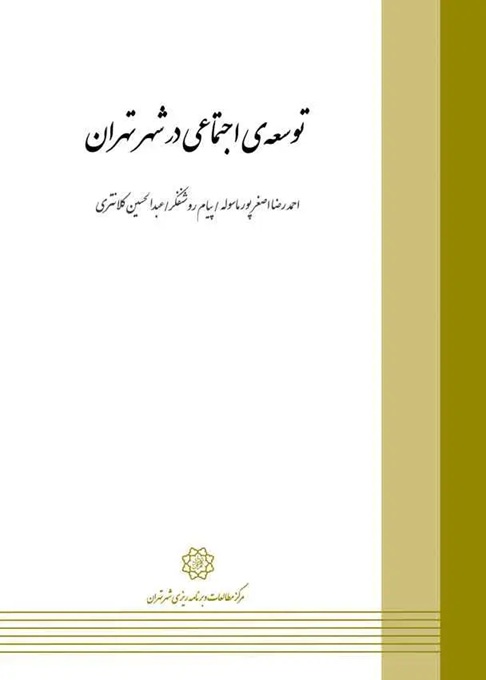
The book examines development beyond economic growth and explores its relationship with citizens’ quality of life, social justice, public participation, social capital, social cohesion, and equal access to opportunities and urban services. The author emphasizes that sustainable urban development cannot be achieved without addressing social dimensions and the needs of diverse groups within society.
Focusing on Tehran, the book analyzes the social challenges of the metropolis and the factors influencing social development or the reproduction of inequalities. Issues such as social and spatial disparities among urban districts, citizen participation in urban governance, the role of social institutions, the conditions of different population groups, and the importance of evidence-based policymaking are among the key themes explored. The book provides a comprehensive perspective on the capacities and barriers to social development in Tehran, highlighting that urban challenges cannot be addressed solely through physical and economic solutions but require serious attention to social relationships, community resources, and human capital.
“Social Development in Tehran City” is a valuable resource for researchers, urban policymakers, social science scholars, students of sociology, urban studies, and social policy. By emphasizing the importance of a social approach to urban planning and management, the book advocates for the development of a more inclusive, equitable, and participatory city—one in which all social groups have the opportunity to participate, contribute, and benefit from the processes of urban development.